I want to tell you about the moment I stopped believing my own hype.
For years, as a work-life consultant and leadership coach, I sat across from exhausted people, people who had done everything “right” and still felt like they were drowning. They talked about toxic cultures, bosses who treated access to their people like a birthright, and meetings that ate the day and left nothing for the parts of life that actually mattered.
And every time, some part of me wanted to hand them the same prescription the whole culture was handing out: get free. Leave the job. Ditch the 9-to-5. Build the thing that lets you work four hours a week and sleep your way to a paycheck.
I believed that story once, I believed it so completely that I lived it. I walked away and built something of my own and found myself working twenty-four-plus hours in a day I swore would finally be mine. That’s when I learned something I couldn’t have learned any other way: freedom from stewarding someone else’s business and freedom from building your own are not the same freedom at all. One just trades one weight for another and calls it liberation.
So when a client of mine did exactly what the culture promised would fix everything, walked away from the grind, built the flexible life, finally had all the freedom she’d been chasing, and looked at me and said, “I don’t understand. I have everything I asked for. Why do I feel so empty?” I didn’t have a clever answer for her. I just recognized the question. I had asked it myself.
That question cracked something open in me, because here’s the truth I didn’t want to look at:
Freedom, by itself, was never going to fix us.
Freedom From Is Not the Same as Freedom For
Here’s what I’ve come to believe: the stories we tell ourselves about freedom usually stop at the exit, because we’ve convinced ourselves the exit is the only option.
We leave the toxic workplace. We escape the micromanager. We finally own our calendar. And for a minute, it feels like breathing after holding your breath too long. That’s real, and that’s good for us, I’m not going to stand here and tell you that relief doesn’t matter. But it doesn’t end there.
I’ve also watched the opposite happen: situations where the toxicity itself became the soil for purpose, and something remarkable grew right out of it, no exit required. And the more I’ve sat with that, the more I believe the difference isn’t the circumstance at all. It’s the why underneath the choice we make about it.
Because here’s the thing about freedom, we all want it, but we rarely want the same version of it. An eighteen-year-old craves the freedom to finally be alone. A fresh graduate craves the freedom to make their own money, answer to no one, and build something with their own name on it. A couple craves the freedom to feel free within a union, even while they’re afraid of the commitment that living alone never asked of them.
We are all reaching for freedom. We are just reaching for wildly different things and calling them by the same name.
And underneath every version of it is the same quiet boundary line: the boundary of freedom is accountability. Freedom is costly it always has been. We just don’t feel the bill until we’re already holding it.
That’s when the quiet comes. And in that quiet, a harder question waits for us, one most of us are too afraid to ask out loud:
Free for what?
Because freedom without direction isn’t liberation, it’s drifting. Freedom without responsibility isn’t peace; it’s entitlement wearing a peaceful face. And freedom without purpose doesn’t feel like freedom for long; it starts to feel like comfort, and comfort, left unexamined, has a way of becoming its own kind of cage.
I don’t say this to shame anyone chasing an exit. I say it because I’ve been in that cage. I know what it looks like from the inside, and I know it’s dressed up to look exactly like the thing we said we wanted.
This is where I believe the real work-life conversation has to begin, not “more work” or “less work,” but something braver: better work, truer systems, and a deeper respect for what a human being actually needs to thrive. That starts with knowing how to live responsibly with freedom, and it’s built on the seven principles below.
The 7 Principles of Responsible Freedom
1. Freedom Must Have Direction
More choices don’t help you if you don’t know where you’re going, purpose is what turns freedom into a path instead of a wander.
2. Freedom Must Carry Responsibility
Freedom was never meant to be the absence of accountability. We get to choose, and we have to own what our choices cost and what they build. This is the bill I mentioned, it always comes.
3. Freedom Must Create Value
Ask yourself the question I ask myself on the hard days: what does my freedom allow me to give, not consume, but give? That’s the highest use of it.
4. Freedom Requires Structure
I know this one sounds like a contradiction, but structure doesn’t always cage us sometimes it’s the very thing that sets us free. Your boundaries, your calendar, your routines can be the scaffolding that lets you actually show up for what matters most. I learned this the hard way, twenty-four hours into my own “freedom.”
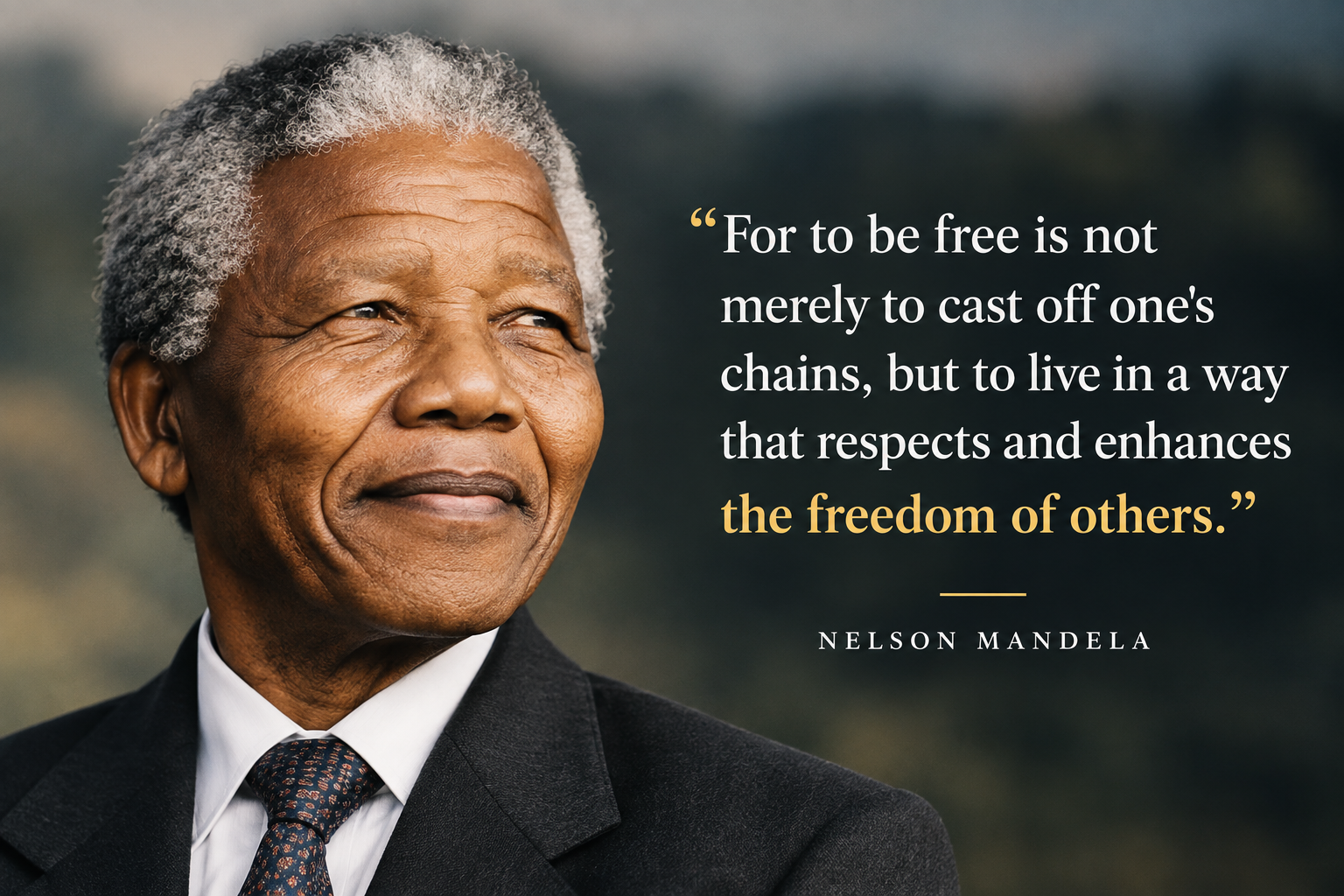
5. Freedom Must Respect Others
My freedom cannot be someone else’s burden not my employees’, not my family’s, not my team’s. We are connected whether we admit it or not, and freedom that ignores that connection isn’t freedom. It’s avoidance.
6. Freedom Must Preserve Capacity
This is the one closest to my heart. If your work drains every ounce of your physical, emotional, relational, and creative capacity, there is nothing left to give the people who need you. And if your freedom removes every challenge, every stretch, every reason to grow, you can lose capacity that way too. Preservation is the balance between the two.
7. Freedom Should Expand Legacy
Here’s the question I want to leave you with: what is my freedom making possible for the people who come after me? Maybe it’s a company. Maybe it’s the children you’re raising. Maybe it’s the person you mentor, the community you serve, or simply becoming the person you were made to become. That’s freedom with a reason freedom that outlives you.
And Leaders, This One’s for You Too
This isn’t only a conversation for employees dreaming of an exit. Organizations have their own version of “free freedom”, and it looks like unlimited access to people’s time, energy, and attention.
I’ve sat in rooms where a company demanded eight hours in the office, but four of those hours were swallowed by meetings that should have been an email, inefficiency nobody wanted to name, and communication that was really just noise. That’s not optimizing human value. That’s consuming human beings and calling it culture.
The future of work can’t keep asking, “How many hours can we get from people?” It has to ask something braver: “How much meaningful value can we create while protecting the humanity of the people creating it?”
That’s a different philosophy of work, and I believe it’s the one we’re overdue to have.
The Question Underneath the Question
Work-life balance was never supposed to mean how little can I get away with doing. And it was never supposed to mean how much of myself can my job take before there’s nothing left.
I think it means something far more courageous:
How do I intentionally steward my time, energy, purpose, relationships, and work so that my life creates something of value without destroying the human being living it?
That’s the conversation I keep coming back to. Not “how do I become free,” but:
What am I becoming free for?
I don’t think that’s a question you answer once. I think it’s one you sit with, wrestle with, and come back to at every season of your life and leadership whether you’re eighteen and craving solitude, freshly graduated and craving your own name on something, or years into a marriage still learning what it means to be free within a commitment instead of free from one.
Let’s Have This Conversation Together
If you’re a leader, CEO, HR professional, or entrepreneur who already knows deep down that another surface-level talk about “flexibility” and “burnout prevention” isn’t going to cut it, I want to invite you into something bigger because the future of work was never just about protecting jobs. It’s about protecting the human beings who make the jobs, the families, the companies, and the communities possible in the first place.
This is only the beginning of that conversation, and I don’t want to have it alone. So here’s my invitation to you:
Take ten minutes this week. Sit somewhere quiet. And ask yourself the question honestly: no performance, no polish, just the truth:
What am I becoming free for?
Then come tell me your answer. Reply to this post, send me a message, or book a CLARITY CALL with me, I’d be honored to sit with you in it, whatever it is.
Because I believe the most courageous thing any of us can do right now isn’t chasing more freedom. It’s finally deciding what our freedom is for.
I’d love to hear your answer.
CLICK TO BOOK YOUR CLARITY CALL
